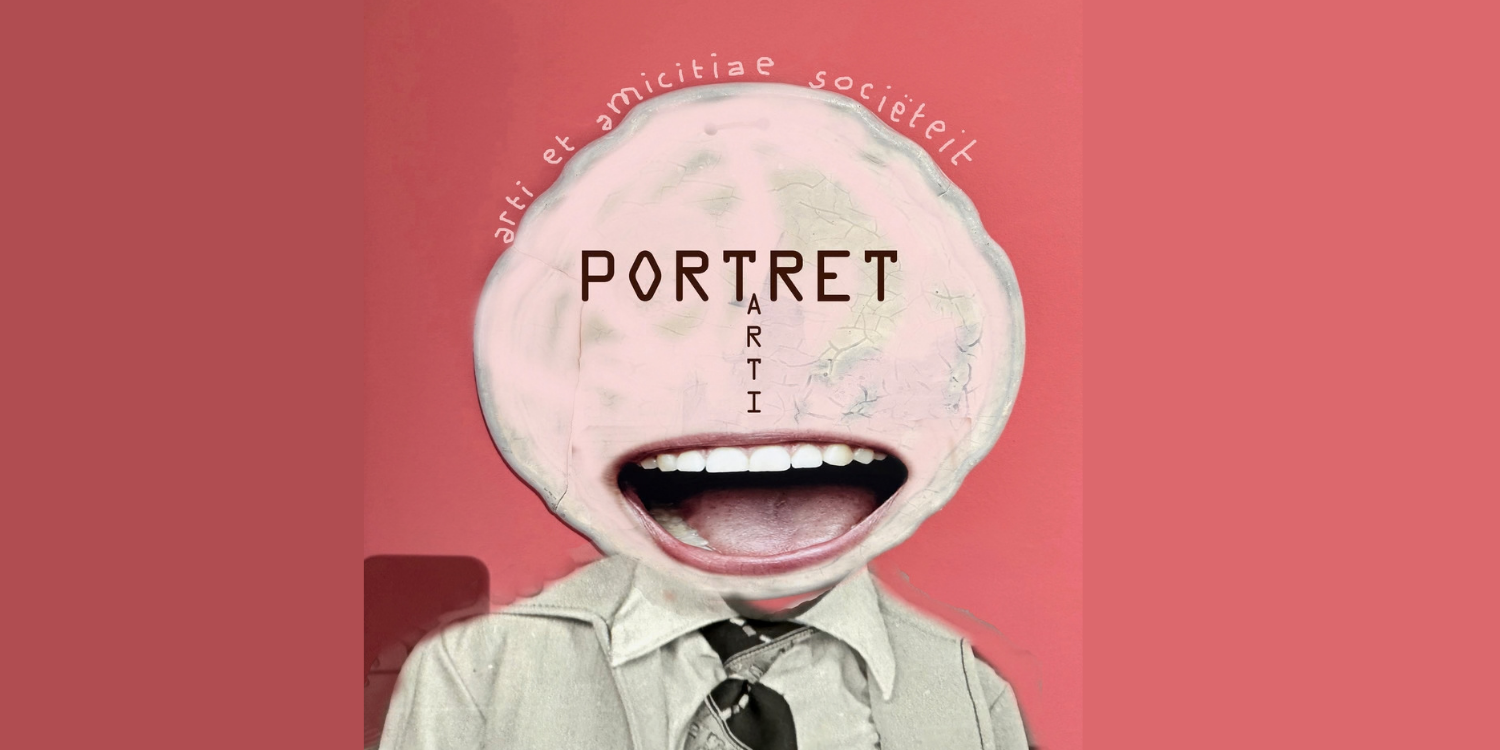
Portretten, waar ze moeten hangen
The oldest known portraits were death masks intended to protect the deceased from evil spirits. A form of deception. “Dear spirit, I am not dead, and I will not die.” Over time, the spirits became less important, and not-dying took precedence; portraits acquired a sense of eternity. Realistically painted, though in accordance with the fashion of the spirit of the age. Gradually, alongside likeness, revealing a personality behind the portrait became important. Emotions, expressions, a soul. And portraits emerged of people who never existed. The evil spirits had to seek psychological treatment. Back to the intention: the exhibition aims to keep the evil spirits outside Arti. Nothing more, nothing less.
Participants:
Bob Bunck
To create a good portrait without meeting the prevailing conditions that define a good portrait—that seemed like a fine challenge to me. And then, as a result, having to answer the question: what is good?
Timon Hagen
In 2016, the Rijksmuseum in Amsterdam displayed two life-sized replicas of portraits by Rembrandt in the entrance hall. The cutouts for the faces allow visitors to stick their heads through the holes, just like at a fairground attraction.
Erik Romme
“Once you stood beautiful and tall in the evening street” — Alex Roeka
Marieke Geerlings
I made this portrait the day before my husband passed away, while keeping vigil by his side. He himself knew he was going to die. You can see the calm in his face. Just before he died, he said: “I was happy.”
Wilma Laarakker
A portrait can take many forms.
This sweet girl is a portrait, in both the literal and figurative sense of the word.
Miyuki Ichijo
We wear masks for protection—masks so ingenious that we often remain unaware of them ourselves. To me, the “true self” resides within the strange complexities of the mind. I paint to discover that hidden reality.
Don Duyns
The artist as an oil fritter, surrounded by his own fears. That is how I interpreted PORTRAIT. A canvas that has taken on many forms. Now finished.
Anne Verhoijsen
This is a drawn portrait which I then, in collaboration with the Weaving Museum in Geldrop, transformed into a jacquard woven wall hanging.
Joop Stoop
The name ‘Orang Malu’ means ‘shy person’. The figure is curled up in shame for the evil and suffering in the world. But now he looks at us, his eyes full of sorrow for what he sees around him. Orang Malu is a Buddha of Indonesian origin.
Irene Janze
My portrait is a portrait of Alfred from 2021. Alfred speaks with the souls, the ghosts, and the angels fluttering around him, although he has partly absorbed some of them.
Celine Oldenhage
Portrait studies of members of the artists’ society Arti et Amicitiae, drawn on the reverse side of old exhibition catalogues and auction lists from the archive. Based on the dating of the paper used, the sketches likely originated around 1922. They were probably made on the spot, during member meetings or gatherings in the exhibition halls, offering an intimate glimpse into the life of the society.
Katelijne Davids
Me and my heavenly cat Okkie
Sander Stada
Me, myself and I
Rob Jongbloed
A portrait often outlives the person portrayed or the maker of the portrait. Michel Snoep passed away in 2016. In 1981, he made this portrait of me and for me. Michel was a friend and a fellow artist (yes, those are two different things).
Flight Lieutenant John Peters was shot down in 1991 during the Gulf War along with his navigator John Nichol in their Tornado fighter jet. On the left as he was shown on TV by the Iraqis after being mistreated, and on the right upon his release.
Henrik Barends and Anneke Pijnappel
Adam Popo: My Muse [2019–2020]
“Beautiful people, pretty talk, beautiful art—you should distrust them.
Ugly can be more interesting than beautiful!”
Alexandra Rouppe van der Voort
Portraits were instilled in me from an early age; my father was a psychiatrist, and my mother is an artist. Looking and listening intensely became my daily life. And so my art of observation developed into a personal style: through painting, photography, and make-up into ‘Emotional Anatomy’.
Ismihan Arslan
For this exhibition, the cooks Bert and Albert of Arti et Amicitiae are portrayed. With attention and love, we depict their many years of dedication. We also pause to mark Bert’s farewell.
Agniet Snoep
From the series Abyss. The series arose from my response to current political and social hardening. In Abyss, I depict man in free fall: confronted with loss of control and power, reaching back to the past to maintain control.
Ammetje Schook
Portraits in woodcuts of four visual artists, three philosophers, and one composer. The philosophers are Confucius, Erasmus, and Spinoza; the painters are Morandi, Monet, Vallotton, and Van Gogh. And a portrait of the composer Satie.
Annie Schoterman
“Arnon Grunberg on the beach”
For years I have been making ‘FACES’, a reflection of my own head (inner self) and of the people and events I encounter. For me, it is not interesting to depict only the exterior; I try to crawl inside someone I find interesting and attempt to show an image or imagination of that.
Bea van Huijstee
“Rocklyn” — This portrait is my only portrait of a person of color, a Ghanaian girl.
After leaving the Rijksakademie, I have been making portraits ever since. Many commissioned works across the country: many children, sometimes entire families, grandparents, daughters, and later their children again.
Dirk Jan Jager
Portrait of Maarten van Roozendaal (1962–2013)
Maarten was a brilliant cabaret performer, singer, and songwriter. I know him from Heiloo, where we were both born.
Eliane Gerrits
From the series “Passers-by,” from when I lived on the Keizersgracht.
Fer Bank
“Portrait of M”
As all my work stems from personal experiences, this portrait is a memory of an actress from my theatre days. Originally it was meant to be part of the series: 600 portraits measuring 30x24 cm each, to be hung closely together—a crowd made up of individuals.
I couldn’t capture her elegance and warmth on that small surface. By enlarging the size, I gained more space to express these qualities through posture and use of color. Thus it became an independent portrait.
Ramon Jan Vet
A portrait is the mirror of the soul. It shows who we are as human beings.
Harald Schole
“Emotional Portrait”
From the series Senses of seven black masks. Inspired by Spinoza’s Ethics and the 48 emotional states described in it, the series explores how emotions are shaped by perception and the senses. In addition to the five traditional senses, Schole adds two: awareness of one’s position relative to the environment and instinct—similar to the natural navigation of migratory birds.
Harry van der Woud
“Vital Urge / Mortal Fear”
My work is often considered self-portraiture, whereas it actually revolves around the human interior (after all, everyone lives in an institution). Intrinsically, the work is about probing the landscape of the soul, an exploration of the human interior. Essentially, the world is approached from within one’s own mind—as the viewer does from within themselves—in dialogue with the environment.
Helma Pantus
“Queen”
All my portraits express something I recognize in others. But first and foremost, it is about making a good painting with the physicality of the paint. The tangibility and physical presence of paint, which you can explore with your senses and which helps tell the story.
Ingeborg Lesener
Self-portrait from 1973
Jan Grotenbreg
“Behind Bars” (Inquisitor from the time of Goya). Painting inspired by the works of Zurbarán, following a trip to Seville. His subjects were usually serious and ascetic religious ceremonies.
John Klinkenberg (Iggy Pop)
“Iggy Pop charcoal”
Seeing Iggy Pop live is an experience of pure energy and raw rock ’n’ roll!
Judith Heinsohn (Paul and Liesje)
“Paul” and “Liesje.” These portraits were drawn at Arti. The reddish-brown color is African clay, which I also use to sculpt my figures. I also use Indian ink and wax crayon.
Kees Slegt
The Actress II
Krikor Momdjan
“Portrait – Broken Heart (thinking of Vincent)”
The portrait is inspired by a childhood photo of myself, thinking of Vincent (van Gogh). It pains me when I think of him.
Malie Baehr
“Portrait of Denise”
My brushstroke is impressionistic, as is my way of seeing. Because I focus on people in their natural environment, I don’t have much time to capture what I see. Therefore, I make quick sketches on the spot, which I later use in my studio. There I try to recreate the atmosphere that struck me.
Margreet Bouman
“Nothing to Fear”
In my work, the self-portrait is central. For years I have been drawing and painting my own head using pencil, watercolor, or bister. It is not about outward resemblance but about the world behind the face. Each portrait is figurative in itself, but together they form an overarching abstract theme of time and space.
Mari Stoel
Stella (woman with eyes closed)
This is a portrait of my partner holding our newborn son. The title refers to the portrait Woman with Eyes Closed by Lucian Freud, which was stolen in 2012 and most likely destroyed.
Marit Dik
In 2020/2021, I made an entire series of portraits about the life of my sister with Down syndrome. She had passed away two years earlier, and I wanted to show moments from her life, because it was so different.
Marjanne Geurtsen
“Tony Double”
These portraits are a tribute to my parents-in-law, created to give their identity and memory a lasting place on earth. By enlarging and drawing details from an old childhood photograph, my visually impaired father-in-law was finally able to truly “see” his late wife again. With these modern Fayum portraits, I offer their (grand)children a tangible remembrance, in which the features of their ancestors visibly live on in the next generation.
Martie van der Loo
“Lady Arti”
Mieke Teelen
“Lady Gaga”
Occasionally, I also make portraits of people who affect me in some way, both positively and negatively.
Minne de Groot
“Appearing”
Today’s world is singing the blues. Tension is palpable, alienation. Where to, and for what purpose?
Natalia Cincunegui
“Yo y mi Sombra / My Shadow and I”
This work is part of a series in which I explore overlapping faces—the persona (mask) and the true face behind it. The universal human image of good and evil.
Neel Korteweg
“Imaginary Amina Dahouda”
A portrait from the book Imaginairen, a leporello with 52 imaginary portraits.
Nynke Deinema
One of the themes in my work is the human being and their incapacity. Much of my work relates to skin or is intended as skin. I do not seek perfection but rather the beauty in imperfection: attraction and repulsion.
Pauline Hille
Philine van der Vegte
“Martijn”
Piet Groenendijk
“Pleasure”
Pieter Athmer
“Hemingway”
Saskia Budding
“Maarten Heijmans”
Sierk van Meeuwen
“Desperate”
The work is inspired by Gustav Courbet’s self-portrait Le Désespéré.
Sylvia Willink
Polak
Thérèse van Gelder
“Louise Bourgeois”
From a series of portraits of female artists intended for a book in which the portraits are first shown alphabetically and then chronologically with specially drawn diagrams. At a glance, these reveal, for example, that before the 19th century women often received their training from fathers or brothers—or how partners played a role, such as marrying a wealthy or influential man.
Trees de Boer
“Contemplation”
A portrait based on a newspaper interview at the time with the CEO of a large company. I found it a fascinating head.
Jacob Siemons
Liesbeth Sevenhuijsen
Passers-by
Mark Roggeveen
Mugshot 5
Marja van Putten
Portrait of my mother based on the last photo I took before she suddenly passed away from Covid.
Ada Leenheer
“Looking”
Joyce van Dongen
This painting was made for the exhibition on Jan Mankes at Museum MORE.
It was originally a portrait of his wife Annie; I turned it into a self-portrait.
Linda Zhang
I have been working on a portrait series titled Shared Silence: Portraits in Pastel and Charcoal.
The series explores quiet moments of stillness across individuals from different cultural backgrounds, focusing on the shared sense of calm and serenity in the human face.
Ella Koopman
Portrait of a lady of a certain age, who has seen life and looks back on it: tired but not dissatisfied.
Dorrit Klomp
The portrait is based on an ancient ideal of beauty, so that women may see themselves as outwardly and inwardly beautiful beings.